
Article · 7 min read · 15 November 2026
Are We Still Thinking for Ourselves?
Becoming unstuck from social media and the influences shaping our thoughts.
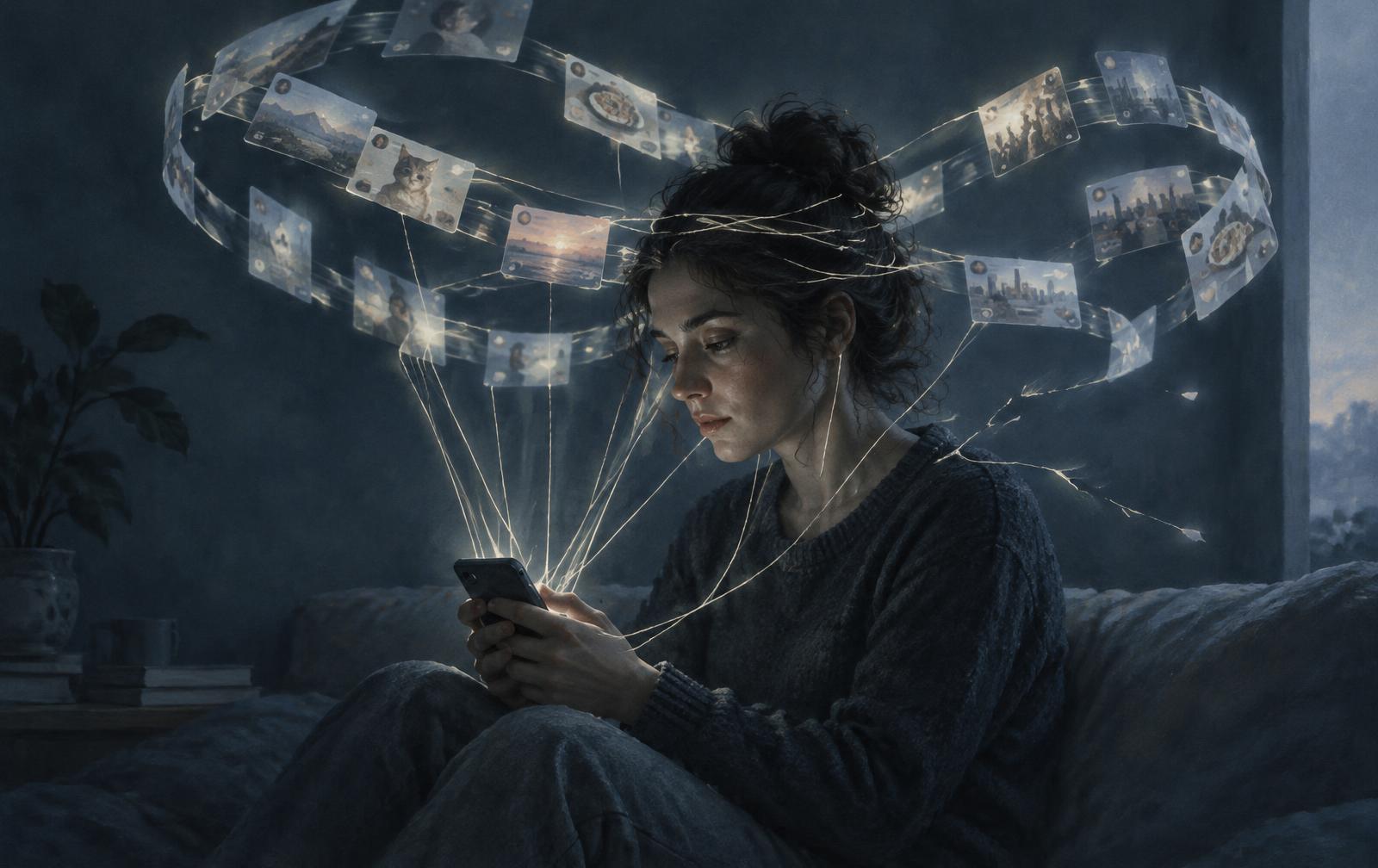
It started off as a way to stay connected to loved ones and friends. We could share photographs, catch up with people we hadn't seen in years and keep in touch with what was happening in each other's lives.
Today, it's a very different story.
We are bombarded with advertising, many of our posts are barely visible to the people we actually know, and much of what appears in front of us has very little to do with why we joined these platforms in the first place.
Social media has become political, commercial and increasingly personal in the way information is presented to us. Our searches, interests, interactions and online behaviour can all contribute to what we are shown next. The more we engage with something, the more likely we are to see something similar.
But have you ever stopped to consider what all of this might be doing to the way you think?
We spend much of our lives believing that our thoughts are our own. But how often do we stop to question where those thoughts came from in the first place?
As a hypnotherapist, I find this particularly interesting because much of what happens on these platforms is not that far removed from the principles of suggestion, repetition and learned behaviour.
The human mind is complicated, but at the same time, certain aspects of our behaviour are remarkably predictable. We learn through experience, association and repetition. The more familiar something becomes, the easier it can be to accept it without giving it the same consideration we might have when we first encountered it.
This doesn't mean we're all walking around in some hypnotic trance. Far from it. But it does mean that our minds can be influenced in ways we don't always recognise.
And that's where I believe we need to pay a little more attention.
Social media companies openly acknowledge collecting information about our activities to personalise advertising and content. What many of us may not fully appreciate is just how much can be learned from the information we provide, often without consciously realising we're providing it.
The websites we visit, the videos we watch, the posts we stop to read, the things we search for and even how long we spend looking at something can all contribute to a picture of our interests and behaviour.
They don't necessarily need to listen to our private conversations to make surprisingly accurate predictions about us. The information we willingly and unknowingly provide can already tell them a great deal.
Algorithms do the rest.
And while much of this is designed to keep us engaged and sell advertising, I wonder whether we've given enough consideration to what happens when the same systems repeatedly present us with particular ideas, opinions and views of the world.
After all, if something keeps appearing in front of you, does it eventually become more believable simply because you've seen it so many times?
Think about the last product you bought because it was recommended to you. Perhaps it was exactly what you needed, or perhaps some very clever marketing convinced you that you needed it in the first place.
Now take that same principle and apply it to information, opinions and beliefs.
What if the article you read wasn't as accurate as you thought? What if the opinions you keep seeing are not necessarily shared by the majority of people, but are simply the opinions an algorithm has learned will keep you interested?
And what if, over time, you begin to accept some of those opinions as your own?
I'm not suggesting that everything we see online is designed to manipulate us or that we are incapable of thinking for ourselves. But I am suggesting that we should be more conscious of the environment in which our thoughts and opinions are being shaped.
We all know about the stage hypnotist convincing some of his unsuspecting guests that they are something they're not. We laugh as they respond to suggestions that seem completely ridiculous to everyone watching.
But here's something worth thinking about.
When we watch a stage hypnotist, we know we're watching a performance. We understand that suggestions are being made and that the people taking part are responding to them.
But what happens when we don't recognise that suggestions are being made in the first place?
What happens when the same ideas, opinions and messages are presented to us repeatedly, not on a stage, but through something we look at every day?
There is no hypnotist standing in front of us, no swinging watch and no one asking us to close our eyes. Just a continuous stream of information, much of it selected according to what we've already shown an interest in.
We hear something often enough and it begins to sound familiar. Familiarity can create a sense of truth, even when we haven't taken the time to question what we're being told.
And perhaps the most interesting part of all of this is that we can become convinced we're making entirely independent decisions.
Who's to say that we haven't already been sold a very convincing idea, view or behaviour pattern?
So, if you're reading this, I want you to imagine that I'm that stage hypnotist.
You've been sitting there, taking everything in, listening to the suggestions and accepting what you've been shown.
But now the performance is coming to an end.
And as I count down from three to one, I'm going to snap my fingers and tell you that this was all an illusion.
Three.
Two.
One.
Snap.
You're back to normal now.
Free from the illusion and free to question what you've been seeing, hearing and believing.
From now on, you will see your online experiences as experiences and no more.
You will recognise that much of what appears in front of you is simply your own activity being mirrored and fed back to you by algorithms designed to keep you engaged.
You will understand that what you are being shown isn't necessarily the world as it is, but a version of it selected according to what these systems believe will hold your attention.
And perhaps, for the first time in a long time, you'll stop and question whether something you believe is genuinely your own conclusion or simply something you've become familiar with.
Of course, I haven't actually hypnotised you. That was never the point.
The point is that we don't always recognise the influences shaping our thoughts until we stop and look at them.
And maybe that's where becoming unstuck really begins.
Not by deleting our social media accounts or turning our backs on technology, but by becoming conscious of how easily our attention, opinions and behaviour can be influenced.
Because this isn't just about social media.
Throughout our lives, we're exposed to the opinions, beliefs and expectations of other people. Our families, our education, our experiences and the society we live in all influence how we see the world.
Some of those influences help us grow, while others may lead us to accept things we've never really questioned.
Social media has simply introduced another influence, one that learns from our behaviour and continually adjusts what it presents to us.
And unlike the people around us, an algorithm doesn't need to understand us as individuals. It only needs to recognise patterns in our behaviour.
The question is whether we recognise those patterns in ourselves.
We were all brought into this world with a unique set of circumstances, and none of us are the same. Our experiences, the people we've met, the mistakes we've made and the things we've learned have all contributed to the individuals we are today.
There is nothing wrong with changing your mind, listening to another point of view or learning something new. That's how we grow as individuals.
But there is a difference between changing your mind because you've considered something for yourself and accepting an idea simply because you've heard it often enough.
So perhaps the next time you find yourself scrolling through social media, stop for a moment.
Question what you're seeing. Question why it's being shown to you. And question whether the opinion you've formed is really your own.
Because there's one question I think we should all ask ourselves occasionally.
Am I thinking for myself, or have I simply learned to think this way?
And if you can recognise the difference, perhaps you don't need anyone to snap their fingers and wake you up after all.
You've already done it yourself.
Comments
If this resonates with you
You're welcome to get in touch about personal coaching.
Enquire About Personal Coaching